

If you’ve ever poured money into a marketing idea that went nowhere, you already know the frustration. Maybe you printed flyers nobody read, or you boosted a social post that got a few likes and zero sales. You’re not alone. Most business owners hit this wall at some point, and the reason usually isn’t effort. It’s strategy.
The businesses that grow consistently today aren’t necessarily the ones spending the most. They’re the ones using digital marketing to reach the right people, at the right time, with the right message. Whether you run a local bakery, a SaaS startup, or a regional service company, learning how to grow your business with digital marketing is no longer optional. It’s the difference between staying visible and getting buried by competitors who show up first on Google, in inboxes, and on social feeds.
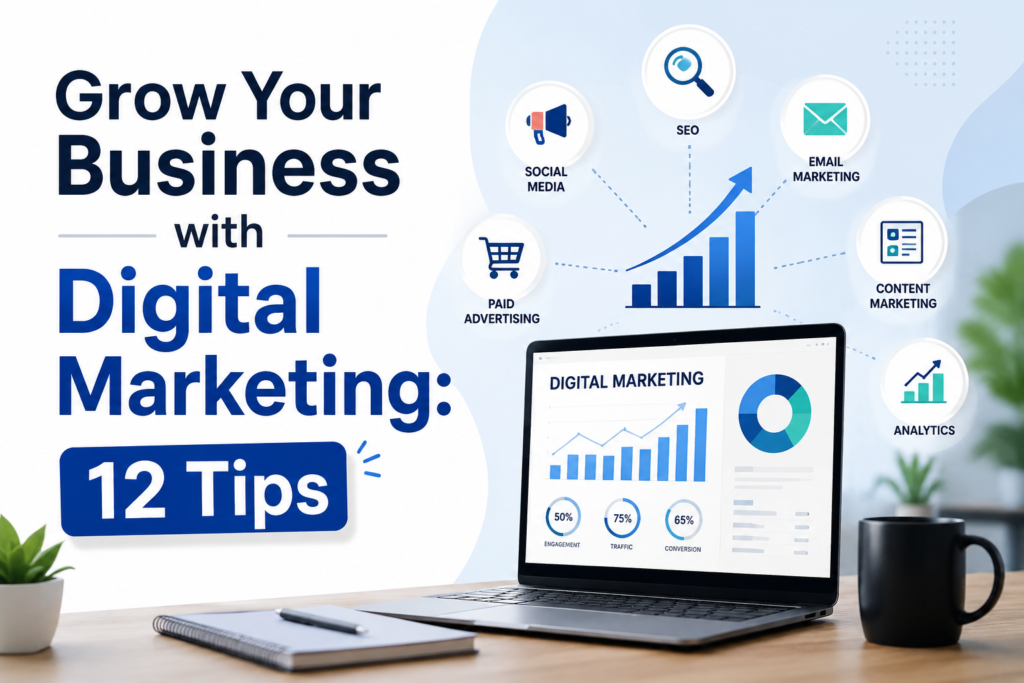
This guide walks through exactly what digital marketing is, why it matters, and 12 proven tactics you can start using this month, even on a tight budget.
What Is Digital Marketing?
Digital marketing is the practice of promoting products, services, or brands using online channels instead of (or alongside) traditional methods like print ads, billboards, or cold calling. It includes everything from search engine optimization and social media to email campaigns and paid advertising.
Unlike traditional marketing, digital marketing lets you target specific audiences, track results in real time, and adjust your approach based on actual data rather than guesswork. That combination of precision and measurability is why so many small businesses have shifted their budgets toward digital channels over the past decade.
At its core, digital marketing covers a few major categories:
- Owned media – your website, blog, and email list
- Earned media – reviews, backlinks, and word-of-mouth mentions
- Paid media – ads on Google, Meta, LinkedIn, and other platforms
A strong strategy usually blends all three, rather than relying on just one channel.
Why Digital Marketing Is Important for Business Growth
Customers don’t discover businesses the way they used to. Before someone calls your business or walks through your door, they’ve usually already searched for you online, checked your reviews, and compared you to at least one competitor.
If your business isn’t visible during that research phase, you’re losing the sale before you even know it existed. That’s the core reason business growth through digital marketing has become essential rather than optional.
Digital marketing also levels the playing field. A small, well-run local business can outrank or outperform a much larger competitor online simply by being more relevant, more helpful, and more responsive to what customers are actually searching for.
Top Benefits of Growing Your Business with Digital Marketing
Before diving into specific tactics, it helps to understand what you’re actually working toward. The benefits of digital marketing tend to fall into a few clear categories:
- Wider reach – Connect with customers beyond your immediate neighborhood or existing network.
- Better targeting – Show your message to people who are already interested, based on behavior, location, or search terms.
- Measurable results – Track clicks, conversions, and revenue instead of guessing what’s working.
- Lower cost per lead – Many digital channels cost less than traditional advertising, especially over time.
- Stronger customer relationships – Email, social media, and reviews let you stay in touch with customers long after the first sale.
- Faster growth cycles – You can test an idea, see results within days, and adjust course quickly.
These advantages compound. A business that consistently applies even a few of them tends to pull ahead of competitors who treat marketing as an afterthought.
12 Proven Digital Marketing Tips to Grow Your Business
Here are the strategies that consistently move the needle, whether you’re just starting out or looking to scale an existing marketing program. These are some of the most effective digital marketing tips to grow your business available today, and none of them require a massive budget to get started.
1. Search
Optimization (SEO)
What it is: SEO is the process of optimizing your website so it ranks higher in search engine results for terms your customers are actually searching.
Why it matters: Search traffic is free once you rank, and it keeps working for you long after you publish. Unlike ads, an SEO-optimized page can generate leads for years without ongoing spend.
Example: A plumbing company optimizes a page for “emergency plumber [city name]” and starts appearing on the first page within a few months, generating calls without paying per click.
Actionable takeaway: Start with keyword research to find terms your customers search for, then optimize your top pages with those keywords in the title, headers, and body copy.
2. Content Marketing
What it is: Creating helpful blog posts, guides, videos, or resources that answer questions your target customers are already asking.
Why it matters: Content builds trust before a customer ever contacts you, and it supports your SEO efforts by giving search engines more relevant pages to index.
Example: A financial advisor publishes a guide on “how to plan for retirement in your 40s” and it becomes a steady source of leads from organic search.
Actionable takeaway: Make a list of the 10 questions your customers ask most often, then write a helpful, honest answer to each one on your blog.
3. Google Business Profile
What it is: A free listing that controls how your business appears on Google Search and Google Maps, including hours, photos, and reviews.
Why it matters: For local businesses, this is often the very first impression a potential customer gets, and an optimized profile can significantly boost local visibility.
Example: A restaurant adds updated photos, responds to reviews, and posts weekly specials on its profile, resulting in a noticeable increase in “near me” searches converting to visits.
Actionable takeaway: Claim and fully complete your Google Business Profile, including categories, photos, and business hours, then update it monthly.
4. Social Media Marketing
What it is: Using platforms like Instagram, Facebook, LinkedIn, or TikTok to build an audience, share updates, and engage directly with customers.
Why it matters: Social media builds familiarity and trust over time, and it gives you a direct line to customers without relying on algorithms from search engines alone.
Example: A boutique clothing store posts styling videos on Instagram and builds a loyal following that regularly shops new arrivals the same day they’re posted.
Actionable takeaway: Pick one or two platforms where your audience actually spends time, and post consistently rather than spreading yourself across every platform.
5. Email Marketing
What it is: Sending targeted messages, offers, and updates to people who’ve opted in to hear from your business.
Why it matters: Email consistently delivers one of the highest returns of any marketing channel because you’re reaching people who’ve already shown interest.
Example: An online retailer sends an abandoned-cart email sequence and recovers a meaningful percentage of sales that would otherwise have been lost.
Actionable takeaway: Start collecting emails through a simple signup incentive, then send one valuable, non-salesy email per week.
6. Pay-Per-Click Advertising (PPC)
What it is: Paid ads on platforms like Google Ads or Meta Ads where you pay only when someone clicks.
Why it matters: PPC delivers fast, measurable results, which makes it useful for testing offers or filling gaps while your organic strategy builds momentum.
Example: A local landscaping company runs a small Google Ads campaign targeting “lawn care near me” and starts booking new jobs within the first week.
Actionable takeaway: Start with a small daily budget on one platform, track your cost per lead closely, and scale only what’s clearly working.
7. Local SEO
What it is: Optimization specifically focused on ranking for location-based searches, such as “coffee shop downtown” or “electrician in [city].”
Why it matters: Most local searches lead to a visit or purchase within a day, making local SEO one of the highest-intent forms of marketing available.
Example: A dental practice optimizes its website and Google Business Profile for its city and surrounding suburbs, and starts appearing in the local map pack for key searches.
Actionable takeaway: Make sure your business name, address, and phone number are consistent across your website, Google profile, and any online directories.
8. Video Marketing
What it is: Using video content, on YouTube, social media, or your website, to explain, demonstrate, or promote your product or service.
Why it matters: Video builds trust faster than text alone and tends to keep visitors engaged longer, which can improve both conversions and search rankings.
Example: A home renovation contractor posts short before-and-after video walkthroughs on YouTube and starts attracting inquiries from people who found the videos through search.
Actionable takeaway: Start with simple, low-production videos, like a product demo or a customer testimonial, rather than waiting for a big-budget shoot.
9. Conversion Rate Optimization (CRO)
What it is: The practice of improving your website so a higher percentage of visitors take the action you want, like filling out a form or making a purchase.
Why it matters: Driving traffic is only half the equation. If your site doesn’t convert visitors, you’re leaving revenue on the table regardless of how much traffic you generate.
Example: An e-commerce store simplifies its checkout process from five steps to two, and sees a clear lift in completed purchases.
Actionable takeaway: Review your website’s main call-to-action buttons and forms. Make sure they’re clear, visible, and require as few steps as possible.
10. Analytics and Performance Tracking
What it is: Using tools like Google Analytics or platform-specific dashboards to measure what’s working and what isn’t.
Why it matters: Without tracking, you’re guessing. With it, you can double down on what’s driving results and cut what’s wasting budget.
Example: A service business notices through analytics that most leads come from one blog post, and shifts more resources toward creating similar content.
Actionable takeaway: Set up basic tracking on your website and check your numbers monthly, focusing on where leads and sales actually come from.
11. Customer Reviews and Reputation Management
What it is: Actively encouraging, monitoring, and responding to customer reviews across Google, Yelp, and industry-specific platforms.
Why it matters: Reviews function as social proof, and businesses with strong, recent reviews consistently earn more trust and more clicks than those without.
Example: A moving company implements a simple post-job email asking for a review, and doubles its review count within a few months, leading to more referral calls.
Actionable takeaway: Ask every satisfied customer for a review, and respond professionally to both positive and negative feedback.
12. Marketing Automation
What it is: Using software to automatically send emails, follow-ups, or messages based on customer behavior, rather than doing it manually.
Why it matters: Automation saves time and ensures no lead falls through the cracks, especially as your business grows and manual follow-up becomes harder to sustain.
Example: A gym sets up an automated welcome series for new sign-ups, improving early engagement and reducing first-month cancellations.
Actionable takeaway: Start small, automate one repetitive task, like a welcome email or appointment reminder, before building out more complex workflows.
Common Mistakes Businesses Make
Even well-intentioned marketing efforts can stall out. Watch for these common pitfalls:
- Trying every channel at once. Spreading a small budget across too many platforms usually means doing all of them poorly.
- Ignoring mobile experience. If your website is slow or hard to navigate on a phone, you’re losing customers before they even see your offer.
- Treating marketing as a one-time project. Growth in digital marketing comes from consistency, not a single campaign.
- Skipping tracking. Without data, it’s impossible to know what’s actually generating leads.
- Copying competitors instead of listening to customers. The best content and offers come from understanding your specific audience’s questions and objections.
- Neglecting existing customers. It’s usually cheaper to keep a customer than to acquire a new one, yet many businesses focus entirely on new leads.
How to Create a Digital Marketing Growth Strategy
You don’t need a 50-page marketing plan to get started. A simple, repeatable framework works better than an overly complex one. Here’s a step-by-step approach:
- Define your goal. Decide what growth actually means for your business right now: more leads, more sales, more repeat customers, or more brand awareness.
- Know your audience. Get specific about who you’re trying to reach, what they search for, and where they spend time online.
- Choose two or three channels. Based on your audience and goal, pick a small number of channels to focus on first, rather than trying to do everything.
- Create a content and posting plan. Map out what you’ll publish and when, whether that’s blog posts, social content, or email newsletters.
- Set a budget for paid efforts. If you’re using ads, start small and track cost per lead closely.
- Track results monthly. Review what’s working, cut what isn’t, and reinvest in your top performers.
- Adjust and repeat. Digital marketing isn’t a “set it and forget it” activity. Revisit your strategy every quarter as your business and market evolve.
This cycle, plan, execute, measure, adjust, is the foundation of sustainable growth in digital marketing, regardless of your industry or budget size.
Future Trends in Digital Marketing
Digital marketing keeps evolving, and a few trends are shaping where things are headed:
- AI-powered marketing. Businesses are increasingly using AI tools to speed up content creation, personalize messaging, and analyze customer data faster than manual methods allow.
- Voice search optimization. As more people use voice assistants, optimizing content for natural, conversational search queries is becoming more important.
- Hyper-personalization. Customers now expect messaging tailored to their specific behavior and preferences, not generic mass campaigns.
- First-party data. As privacy regulations tighten and third-party cookies phase out, businesses that build their own email lists and customer data will have a real advantage over those relying solely on ad platforms.
Staying aware of these shifts now can help you adapt earlier than competitors who wait until a trend becomes unavoidable.
Frequently Asked Questions
1. How long does it take to see results from digital marketing?
It depends on the channel. Paid ads can generate leads within days, while SEO and content marketing typically take three to six months to build meaningful traction.
2. Do small businesses really need digital marketing?
Yes. Most customers research businesses online before making a purchase decision, regardless of business size, which makes visibility essential.
3. What’s the difference between SEO and PPC?
SEO focuses on earning free, organic traffic over time, while PPC involves paying for immediate visibility through ads. Many businesses use both together.
4. How much should a small business budget for digital marketing?
Budgets vary widely by industry and goals, but many small businesses start with a modest monthly budget and scale up as they see measurable returns.
5. Which digital marketing channel gives the best ROI?
Email marketing and SEO are often cited as high-ROI channels because they target people who’ve already shown interest, but the “best” channel depends on your specific audience and goals.
6. Can I do digital marketing myself, or do I need an agency?
Many business owners start by managing basic tactics themselves, like a Google Business Profile and social media, then bring in outside help as their strategy becomes more complex.
7. How often should I post on social media?
Consistency matters more than frequency. Posting a few times a week reliably tends to outperform sporadic bursts of daily posting followed by silence.
8. What’s the first digital marketing step I should take?
Start with your Google Business Profile and a basic, mobile-friendly website. These two elements form the foundation most other digital marketing efforts build on.
Conclusion
Growing a business with digital marketing isn’t about doing everything at once. It’s about choosing the right combination of strategies, staying consistent, and using data to guide your next move. Whether you start with SEO, social media, email, or a Google Business Profile, the key is to begin, track your results, and build from there.
The businesses that grow fastest online usually aren’t the ones with the biggest budgets. They’re the ones that show up consistently, listen to what their customers actually need, and adjust based on real results rather than guesswork.